The truck leaves on Tuesday
In the highlands of Madamba, morning comes cool and slow. Mist lifts off the terraced slopes a little at a time, and the soil underfoot is dark, damp, and soft enough to take a footprint. The sound that carries furthest on a harvest day is a quiet one: bundles of green stalks being stacked, one on another, in the bed of a waiting truck.
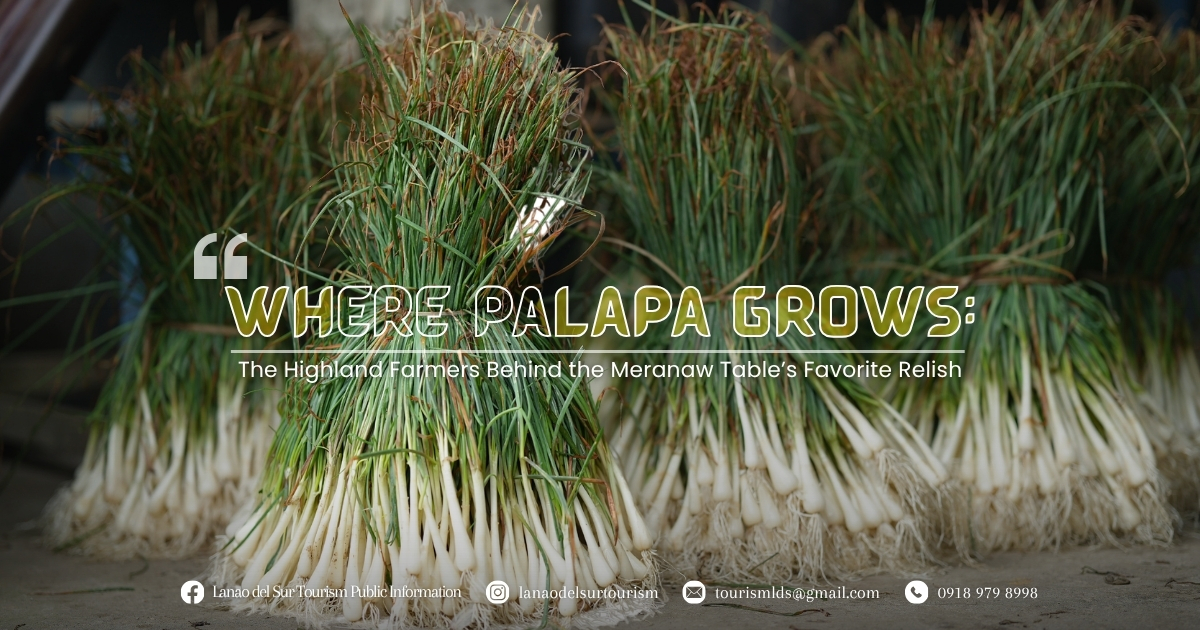
The stalks are sakurab, the native scallion of the Meranaw highlands. They were pulled from the ground that morning, roots still dusted with earth, and tied into small hand-sized bundles. Walk close to the truck and the air turns sharp and green, somewhere between spring onion and garlic, with a sweetness underneath that only a cold-grown allium seems to keep.

By afternoon the truck will be on the road north to Sapad and Salvador in Lanao del Norte. School canteens and restaurant kitchens there are already waiting. The load sent on Monday, the growers say, has sold out.
What those kitchens will make is palapa: sakurab pounded with chili and ginger, often toasted with grated coconut, then cooked down into the fragrant, fiery relish that sits on nearly every Meranaw table. It is spooned over rice, stirred into broth, and eaten with grilled fish. But before it is a condiment, palapa is a crop. And in Madamba, the crop begins with the cold.
A crop that asks for cold
“It needs cold weather,” says Fermida M. H. Said, barangay captain of Salongabanding in neighboring Madalum, where sakurab has been grown for as long as anyone remembers. “It really requires it. It will not thrive in the heat.”
That single condition is why the best sakurab comes from the uplands around Lake Lanao. It is also why growers here read their plots closely. A new planting starts as “just a single stalk, still very small,” Said explains, barely leafed. Over the weeks it fills out and grows lush. When a clump has broadened into four to six stalks, it is ready to be pulled.
The early variety takes three months. Others take four. In Madamba, Amrodin Adompen, president of the 102nd Main Camp Tangsiun Agriculture Cooperative, describes the choice the way a cook might. Pulled young and tender, pakaripsaan, it is ready at three months. Left to fully mature, pakalaga, it takes four.
The quality, Said insists, lives in the ground. “It depends on the oniin (seedling),” she says, the dark, ash-enriched soil of the highland plots. “As long as the oniin is good, the palapa will turn out well.”
The terraced slopes leave no room for sprawling fields. Plots are measured in malong, a local unit of roughly ten meters a side. They are worked in rotation, with sakurab followed by corn before it returns. “You cannot maintain palapa continuously in the same soil without it getting infested with worms and grubs,” Said says. “If you replant palapa right away, the yield diminishes significantly.”
Nor does anyone here buy seedlings if they can help it. After each harvest, growers keep back a strip, about one meter by ten, as propagation stock. From that strip comes enough to replant the whole malong. The plants in the ground today descend, plot by plot, from the plants of decades ago.
In the kitchen, the craft continues by hand. The sakurab is cleaned and chopped, then pounded or ground with fresh chilies and ginger until the oils open and the aroma fills the room. Every household, canteen and restaurant tunes the balance of heat, sharpness and salt to its own taste. Adompen says this is exactly why most of his buyers want the raw stalks rather than a finished jar. They make their own palapa, samida i taam, according to their own flavor.
“This is our work here”

Ask a Meranaw where palapa comes from and the answer is usually a person: a mother, a grandmother, a neighbor whose jar was always better than everyone else’s. In Madamba the answer is also a place. “This has always been our main source of livelihood,” Adompen says. “This is our work here.”
His cooperative takes its name from where it stands, inside the base of the 102nd Brigade. It registered with the local government only about three years ago, but its members were growing sakurab long before that. Today it works more than ten malong of its own. When demand outruns its fields, it buys from other growers nearby, so the harvest keeps moving through the community even when the cooperative’s plots are resting.
The arithmetic is modest and steady, and it matters. More than twenty members harvest, clean and bundle each week. Each takes home around ₱1,000 after deductions. A good malong can bring in ₱20,000 to ₱25,000, depending on the crop. The cooperative ships to the north once or twice a week, wholesale at ₱70 to ₱80 a bundle.
It also bottles. The jar is labeled 102nd Palapa, and Adompen says it with evident pride: “Halal. We even obtained its Halal certification.” A batch of a hundred bottles takes about fifteen bundles of sakurab. Resellers in Marawi buy at ₱120 and sell for ₱150 to ₱160, and orders also arrive online. Adompen’s son cooks the larger orders and has shipped jars as far as Manila. Madamba’s palapa was recently shown there too, at an exhibit under the UNDP Women, Peace and Security Summit.
The Halal mark carries a weight beyond the label. It certifies a food made by Muslim growers, for Muslim tables, to a standard their own faith sets. That makes the jar a way for palapa to travel without losing what it is: to Meranaw families in Manila, and perhaps one day to overseas Filipino and Muslim communities abroad.
Travel is still the hard part. Noryasmin Natibor, the Madalum municipal tourism officer who joined the visit in Madamba, notes that across the highlands the harvest is abundant but processing is scarce. Raw sakurab sent to Manila “wilts and dries out” on the way. A jar of palapa keeps the highland in it. A bundle of stalks, far from the cold, does not.
The strip that stays in the ground
By mid-afternoon the second truck is loaded and gone, carrying the morning’s harvest down out of the cold toward kitchens that will make it their own. Up on the terraces the picked plots lie open, waiting their turn for corn. Beside them, the next plot is already filling out, four to six stalks to a clump.

And at the edge of each harvested malong, if you look, there is a narrow strip left standing: one meter by ten, kept back from the market. Nobody sells it. Nobody eats it. It goes back into the oniin, to become next season’s field.
It may be the truest picture of what Madamba’s palapa is. It is a living inheritance, not a recipe written down somewhere. Each harvest holds back enough of itself to begin again. “Since long ago,” Said says, “there has always been palapa grown here.” In the highlands, they intend to keep it that way.


Leave a Reply